Collect Targeted Customer Leads by Location on Instagram
If you sell to a specific city, neighbourhood, or region, most of your marketing effort is wasted on people who will never walk through your door. A national hashtag brings you leads from three continents; an ad set targets an interest, not a postcode. But Instagram quietly tells you exactly where people are — and that makes it one of the best places to collect leads by location that you can actually serve.
This guide shows you how to find and gather location-based customer leads on Instagram: which location signals to use, how to combine them for precision, how to keep the list clean, and how to automate the collecting so a local pipeline fills itself.
Quick answer: To collect targeted customer leads by location on Instagram, pull usernames from location tags on posts near your service area, then narrow further by combining a location with a niche hashtag or a local competitor’s followers. Filter out visitors and businesses, save each area as its own named list, and gather on slow human-like delays. A Chrome extension like IG Outreach Desk automates location collection so you build reusable, geo-targeted audiences of local buyers hands-off.
Why location targeting beats broad lists
For a local business, a lead you cannot serve is worse than no lead at all — it costs you the same time to contact and returns nothing. A detailer in Brisbane has no use for a follower in Toronto, however engaged they are.
Location targeting flips the maths. When you collect leads by location, every name on the list is somebody you can genuinely sell to, so your reply rate, your close rate and your return on time all climb together. A geo-targeted list of 150 local accounts will out-earn a national list of 1,500 almost every time, because relevance compounds at every step of the funnel.
The other advantage is message quality. “Saw you’re based in [suburb]” is a genuinely personal opener that a national list can never give you — and personal openers are what get replies.
The location signals Instagram gives you
Instagram exposes several ways to tell where an account actually is. These are the ones worth mining, from most precise to least.
Location tags on posts
The strongest signal. When someone tags a place in a post — a café, a gym, a venue, a landmark — they were physically there. Collect the accounts posting from locations inside your service area and you have leads with confirmed geography, which no other targeting method reliably gives you.
Local business followers
The followers of a local competitor or a complementary local business are overwhelmingly local themselves. A neighbourhood gym’s followers are people who live or work nearby — exactly the pool a local service wants.
Location-specific hashtags
Tags like #brisbanecoffee or #manchesterwedding blend place and intent. They carry less volume than a plain location tag but often higher relevance, because the person chose to identify with both the place and the topic.
Commenters on local content
People engaging with a local news account, a community page, or a regional influencer are almost always in the region. Commenters on that content are a warm, geographically-clustered source.
Stacking signals for pinpoint accuracy
One location signal is good. Two overlapping signals is where the precision gets remarkable — and it is the single biggest difference between a mediocre local list and a great one.
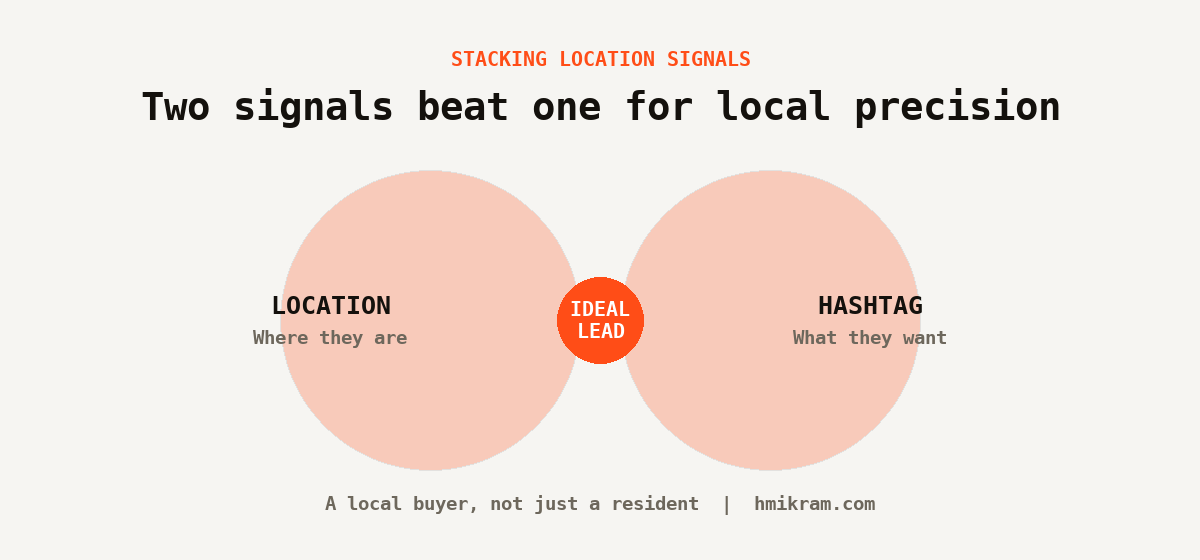
The idea is to find accounts that satisfy two conditions at once, so you are collecting people who are both in your area and interested in your thing:
- Location tag + niche hashtag. People who posted from your city and used an industry hashtag — a buyer, not just a resident.
- Local competitor’s followers + your service hashtag. Nearby people already following a business like yours.
- Neighbourhood venue + recent activity. People who posted from a specific spot in the last few weeks, so the list is fresh rather than stale.
Each layer you add shrinks the list and raises its quality. When you collect leads by location this way, a smaller, sharper audience beats a bigger vague one every time.
Which businesses this works best for
Location-based lead collection is not for everyone — but for the right business it is close to unfair.
| Business type | Why location targeting works |
|---|---|
| Mobile & home services | Detailers, cleaners, trades — you only serve a drive-time radius |
| Salons, gyms & studios | Customers come to a physical address, so proximity is everything |
| Real estate agents | Every lead must be in-market for a specific area |
| Restaurants & venues | Foot traffic lives within a few kilometres |
| Local B2B & events | Regional clients and attendees you can meet in person |
If your customers have to be physically near you to buy, location is the most valuable filter Instagram offers. If you sell digitally to anyone anywhere, the six general sources in the guide to collecting leads from Instagram will serve you better.
Filtering out tourists and businesses
A raw location scrape catches two groups you usually don’t want: people passing through, and other businesses. Both dilute a local list.
Screen out visitors. A quick look at a profile usually reveals whether someone lives in the area or was there on holiday. On a venue with heavy tourist traffic, lean on the location-plus-hashtag stack instead of the raw tag, since residents are the ones using local hashtags.
Screen out businesses, unless you sell B2B. Other shops, agencies and competitors clutter a consumer list and can get you reported if you message them.
Then name the list by area. Save each region separately — gyms-northside-may, not leads — so you can run different offers, timing, or messaging per neighbourhood and track which area actually converts.
Automating location-based collection
Gathering location leads by hand means opening a place tag, checking each poster’s profile for their real location, and copying the ones that fit — one at a time. It works, and it is exhausting, which is why most local businesses do it once and never again.
IG Outreach Desk automates it. The Chrome extension collects accounts from any location tag, saves each area as a reusable named audience with automatic duplicate protection, and runs on the slow human-like delays that keep collecting safe — all inside your normal logged-in session. You can build a separate geo-targeted list for every neighbourhood you serve and refresh them whenever you need more.
As always, automation carries some risk and staying within Instagram’s terms of service is your responsibility. For the safe delay ranges and hourly limits, see the safe-limits section of the outreach guide; Instagram’s own Help Center is the authority on what’s permitted.
Frequently asked questions
How do I find leads by location on Instagram?
Use Instagram’s place search to open a location tag near your service area, then collect the accounts posting from there. Combine the location with a niche hashtag or a local competitor’s followers to narrow the list to people who are both nearby and interested in what you sell.
Can I collect leads from a specific city or neighbourhood?
Yes. Location tags work right down to individual venues, so you can target a single suburb, a shopping district, or even one popular spot rather than a whole city. The more specific the place, the more precise the resulting list.
How accurate is Instagram location targeting?
A location tag confirms someone was physically at that place when they posted, which is more reliable than interest-based targeting. It is not perfect — tourists and one-time visitors appear too — so a quick profile check or a second overlapping signal keeps the list clean.
Is collecting leads by location against Instagram’s rules?
Collecting publicly visible usernames is broadly comparable to noting public information, but automated collection can conflict with Instagram’s terms of service, and using the data is subject to privacy laws in some regions. Collect responsibly, contact people relevantly, and treat Instagram’s terms as the boundary.
What businesses benefit most from location-based leads?
Any business whose customers must be physically nearby — mobile and home services, salons, gyms, restaurants, real estate agents, and local B2B or events. If you sell digitally to anyone anywhere, broad interest-based sources serve you better than location.
Do I need the customer’s exact address to target by location?
No. You are targeting the public places people choose to tag, not private addresses. You collect accounts associated with a location tag, which tells you the general area someone frequents without any access to personal address data.
Pick one area and start there
The fastest way to prove this works is to choose a single location that matters to your business — one busy venue, one neighbourhood — collect a couple of hundred local accounts, filter out the visitors and businesses, and save the batch by area. You will have a list of people you can genuinely serve, with a personal opener built in.
When collecting each area by hand becomes the chore you keep skipping, IG Outreach Desk was built to collect leads by location for you — safely, one reusable audience per neighbourhood.